
The Slidabox can be modified and personalised in many ways. For instance, if you wanted a simpler, lighter and cheaper version you could just make it without the drawer. You would then have two doors (or just one if you wanted) and it would weigh a mere 220 kilos or so including the trailer. The bed would be wide enough but the down side would be a pair of slightly encroaching wheel arches although the upside of that is that they could be used as a bed side table and somewhere to put a cup of tea. The amount of storage available would also be less as your feet would take up most of it.
If you decide to do a drawer delete you don't necessarily have to move the axle back But you must be careful to ensure there is about 15 kilos on the tow bar when towing or risk instability on the road. It's easy enough to place heavy items in the front of the caravan to bring the weight forward or you can move the axle back a little if you preferred. You can use pretty much any small single axle trailer to build your Slidabox on. Depending on the width of the trailer you can either build it between the wheels or over them and of course the plans discuss all these choices.
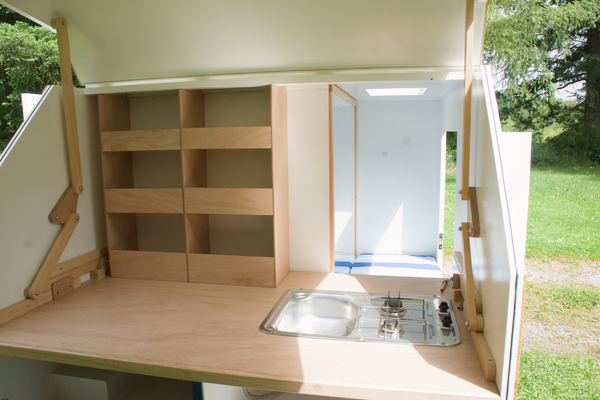
One thing I never liked very much about traditional tear drops is that there never seems to be any access to the galley area at the back of the caravan from inside the caravan. You have to go outside to use it. That might be fine for dry places but in Europe the idea of having to go out in the rain just to make a cup of tea is anathema to me so one great advantage of the drawer is that when it's open it gives access to the galley and storage area so you don't have to go outside to use the galley if you don't want to.
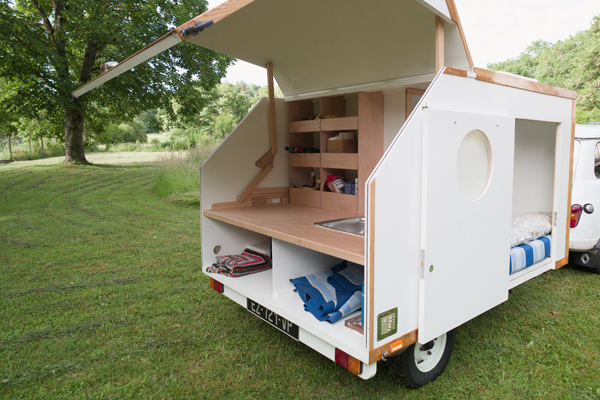
By having the drawer slide out for the bed means there is much more space at the back for the galley and storage. Of course it's not always raining in Europe so time will be spent outside cooking too. The rear hatch, when open, covers the whole galley so that you can cook outside protected from the elements. Another feature of the Slidabox often missing from tear drops is a gutter system which stops water getting to the galley when it's closed but also when it's open.
The construction technique of the Slidabox follows the proven system used by the previous designs and pioneered in the Slidavan, that of using a very light insulation element glued between two thin layers of plywood. This insulated composite panel is easy to make, strong and light with the added bonus of using cheap and easily obtained materials. You don't need any special tools but you do need a lot of clamps. The panels simply screw to one another so no framework is needed which simplifies everything and saves weight and time.
Having decided on the basic concept I proceeded to design the slidabox. Wherever possible I like to reduce waste so rather than start designing something to a specific size I first consider the dimensions of available materials. In the case of the Slidavan it is 2.5 metres long because that is the length of one sheet of plywood. The Slidabox, being effectively a tear drop has only sitting headroom only and as luck would have it a sheet of plywood is 1.2 metre wide which is about a perfect amount to give enough sitting headroom for the tallest camper.
By having a drawer slide out, a concept very easy to understand and use, the dimensions of the Slidabox could be kept as small as possible. When the drawer is open the Slidabox goes from 1.5 metres wide to over 2 metres which makes for a very long, comfy and fully insulated bed. In fact as the drawer only comes out about a third of the way out (the rest stays inside) the bed is actually double insulated.
In order to create enough space to allow a drawer, the trailer axle needs to be moved backwards. This normally an easy enough thing to do so long as the trailer you have chosen has a bolt on axle. There are advantages and disadvantages to moving the axle back. The advantages are that it allows for a drawer but also increases stability on the road and allows the rear of the caravan to be loaded up with weight which would be perfectly placed above the axle. The downside of moving the axle back is that it increases the weight on the tow hitch which can be a problem with small cars.
The rear hatch offers a few features, apart from being big enough to protect you when it's open, you can also add a simple privacy curtain to it creating a good space where you can change or shower. There is also the automatic gravity support system which holds the hatch up.
This was something completely unnecessary really as a simple stick works flawlessly with little effort and cost where the gravity system is a bit more involved! But there's no doubting it's most amusing and a great talking point. It's up to you, you can build it if you want or not.
This idea came about as I was waiting for some more glue for finishing gluing up the panels. I had nothing to do so started to experiment with the idea to see if it was feasible. I started by knocking up a very crude hatch approximation on the worktop. By trial and error I was able to prove the validity of the idea. From that I made a second version with more precision where some problems came to light. Once I was happy with the geometry I decided to commit to a full size version to actually fit in the Slidabox which works very nicely indeed and is such fun to watch and use.
You can paint or varnish your Slidabox, you could even 'wrap' it with a design or colour of your choice. The Slidabox you see here is simply painted white to keep the sun from heating up the interior too much but also because it's a nice smart contrast to the varnish wood trim fitted all around.

Actually the Slidabox is Woodenwidget's fifth caravan design. That fact surprised me as all our original designs were boats. Perhaps it's not surprising that Woodenwidget took this turn. When the boats were designed I was living on a boat and the folding dinghies were designed through necessity as I strove to find the right dinghy for my small yacht. When eventually the yacht was sold and I became a landlubber with a workshop for the first time, it's no surprise that the designs reflected this.
For a long time I had thought about making a tear drop caravan as the shape is fabulous, very cool looking, aerodynamic and actually not so hard to build even if it seems to be with all those curves. But the market is saturated with tear drops. There are so many designs and to me they all look the same and if there's one thing I can't bear doing it's copying other designs! So I decided to make a tear drop caravan in the shape of a box, a squaredrop if you like! When I designed the Slidavan telescopic caravan it too was basically a box but with a curved roof and as we all know a box is about as far from an aerodynamic shape as it's possible to get but I figured if I moved it closer to the tow car and made it small enough that it wouldn't matter if it wasn't aerodynamic because it would be mostly tucked in behind the tow car and hidden in its wake.
The Slidavan was tested by me over many thousands of kilometers, I even lived in it for three months! One of the things that really surprised me was just how little the fuel consumption was affected towing it. Basically it proved my theory so when it came to design the Slidabox I knew that I could get away without a sleek shape. Whereas the Slidavan is a box with a curved top which I added to increase the headroom but also to try and make it a bit less 'box like' the Slidabox is simply and unashamedly a box.
But a box has much to offer. It's by far the easiest shape to make and offers the biggest interior volume. It's wastes less materials and is cheaper and faster to make than anything with shape to it. Plus it's likely that first time builders would not be intimidated building something so simple. The trouble, from my point of view as a designer would be how to cheer it up and make it look attractive when it's so obviously just a box!
All that said, a box is much like any other box and all Woodenwidget designs need to do more and be interesting and practical. Plus most of the other designs offer solutions to the spatially challenged so if it could be made smaller and lighter because of some clever feature then that would help to make it more than just a box.
With most tear drop campers you sleep length ways and that's fine I guess but I thought I quite liked the idea of something that expanded. Many campers and even campervans have extending parts which lift up or fold out but they mostly use fabric which if you've ever spent a night in a tent will know does not offer much in the way of protection from the elements so I wanted the Slidabox, like the Plystream and the Slidavan before it to have full insulation.

Twenty years ago I created Woodenwidget. It began with one small folding dinghy, the Origami. From there the designs evolved and developed in to the site you see today. Woodenwidget's penultimate design was the Plystream, a lightweight aerodynamic caravan. Not so hard to make really but certainly more involved than say an Origami dinghy.
When I began way back in 2006 I wanted to offer designs so simple and inclusive that anyone, regardless of their experience could make our designs using our clever step by step plans. Perhaps over the years I may have strayed a little from that original idea and it's fair to say that although none of the designs are particularly hard to make some are harder than others. I thought it was about time to get back to basics and create a design that was really simple to make but also one that looked simple. One that folk might look at and think, 'I could make that!' And so was born the Slidabox.