
The finished frame weighed just three kilos and the whole bike only 12 which is perfectly acceptable. Not as light as a carbon racing bike, but still lighter than many bikes. The seat height is fixed but being long means a taller rider simply sits a bit further back on it. You can ride two up if you like and in fact I even tried it three up with me sitting quite comfortably on the wide cross bar. A great feature of the Hoopy is that when you stop you can sit on the cross bar and relax. Something you certainly can't do on a conventional bike! The hollow frame offers some storage, a place to stuff things like a rain jacket or a pump or water bottle or whatever you fancy.
When the Hoopy was launched it was well received and quite a few plans have since been sold. One that was built found its way on to Ebay where it was bought by a certain Sam Pilgrim who then tried his best to wreck it, just to see how strong it was. he really did abuse it and he did manage to break a wheel and the crank but the frame remained intact which as a designer I found extremely gratifying. Believing that a design is sound and strong is not the same as knowing it is. You can find Sam's videos on YouTube.
Everyone who rides the Hoopy loves it. I think they are surprised at how well it rides. I don't know why people do not expect a wooden bicycle to ride well. Wood is a fantastic material and plywood is wood that has had all the disadvantages engineered out of it. We live in fabulous times...
Suddenly I wondered why I would even bother making such a complicated version from many riveted hoops when a few pieces of glued plywood worked so well and looked so good. Then of course the idea of making plans arose. I could never make plans for a Hoopy made of steamed wood as the level of skill needed would be too high for most people and it would not fit in with Woodenwidget's philosophy of offering easy to build designs but this epoxied plywood Hoopy definitely would.
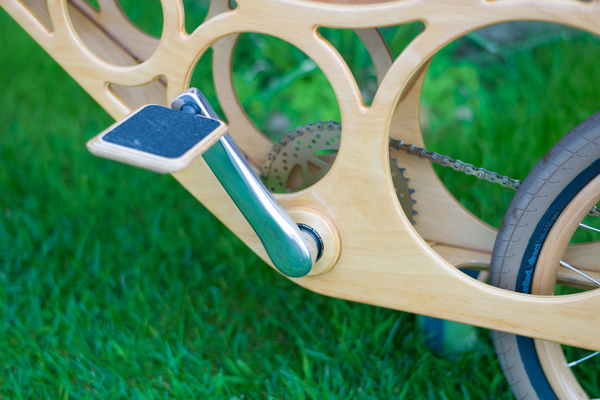
Having proved the validity of the idea I produced the plans and decided to make a second one with higher quality materials taking more care during the build. I really took my time to do a nice job. Just varnishing the frame took 20 hours! I forked out on a pair of very expensive carbon reinforced wooden wheels from Cerchio Ghisallo and got them to install a 2 speed auto hub from Sram which also had a back pedal brake built in. What this meant was that I could do away with any kind of cables and have a very clean looking bike with gears and a brake. The Sram system is superb, when you get to a certain speed it changes up a gear and when you slow down it automatically changes down again.
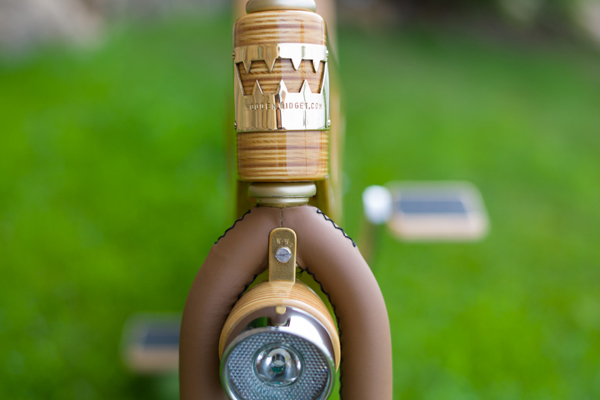
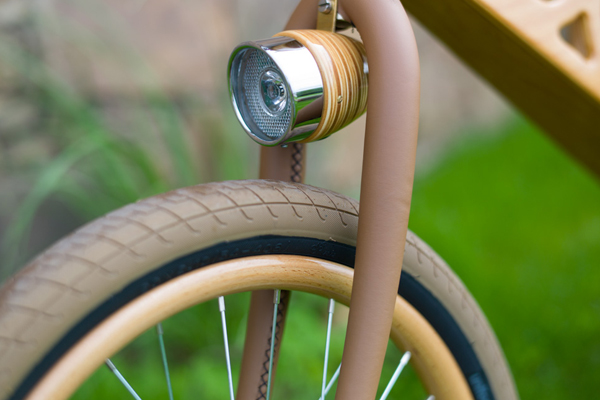
Other nice touches are the wooden handlebar grips and pedals. I wrapped the metal forks in leather, a job that took me two full days but I think it was worth it. I also made wooden lights front and rear. The seat was covered in the same leather and embroidered WW at the back. I even made a brass builder's plate in polished brass for that finishing touch.
The first prototype was built very quickly. I conceived a simple system to hold the wheels in place while the frame was glued up and just two days later I had a finished frame. I really had no idea what I was doing but often this can be a blessing as you are not held by any conventional wisdom. I could do whatever I wanted just to see if it would work. When I first placed the headstock on the frame and stood back to look at it, the angle seemed a bit extreme to me so I adjusted it by eye until it looked about right.
One of the most unusual aspects of the Hoopy is the internal drive sprocket. It adds a cleaner look to the bike and ensures you never get oil on your clothes but did prove to be one of the hardest things to get working reliably. The final design uses a special clamp which tightens over a modified axle which is in turn bonded with a structural epoxy. It's fair to say that without modern epoxy glues the Hoopy would not exist today!
The first prototype was rough around the edges but despite that it surprised me with how well it rode. It was comfy and had a good turn of speed. You could even take your hands off the bars as you were riding along. Later on I started to study bicycle geometry and measured the headstock at 72.5 degrees which turns out to be a good starting point for a cruising bicycle and I had discovered that by eye.
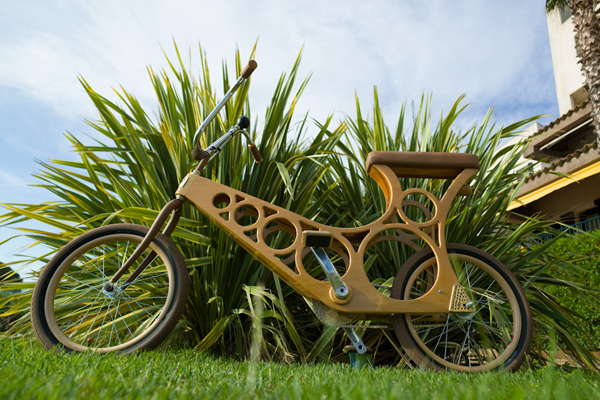
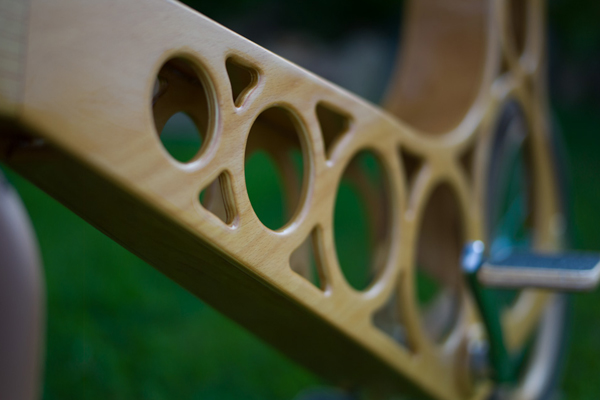
The Hoopy is a design that uses epoxy resin to hold it all together. The only screws in the frame are the ones fitted as location pins and to hold the maker's plate on! The Hoopy had been an idea of mine for a long time. The original idea was to make the frame from steamed hoops of ash wood all riveted together with copper boat nails. It would be a very challenging design to make and I never had any thoughts of offering plans for it. It was just something I thought would make a fun and challenging project.
The trouble is I knew nothing about bicycle geometry. I mean, what makes a bicycle ride well? What angle should the head stock be? What I did not want to do was spend weeks making a stunning work of art which you couldn't ride! So I decided to make a simple version from plywood to find out if it would even work. The design in the frame sides were cut to mimic the original concept of hoops but I could have equally left them solid, or in fact cut pretty much any shape I wanted in them.
Most wooden bikes today, and there are a great many of them, seem to mostly copy the modern 'double triangle' frame shape. I did not agree with this approach. Wood is a different material to steel and I believe needs to be used in a different way to get the best out of it. Plus, I don't like copying existing ideas always preferring to let the qualities of the materials dictate the final form rather than trying to make them conform to some existing standard.